



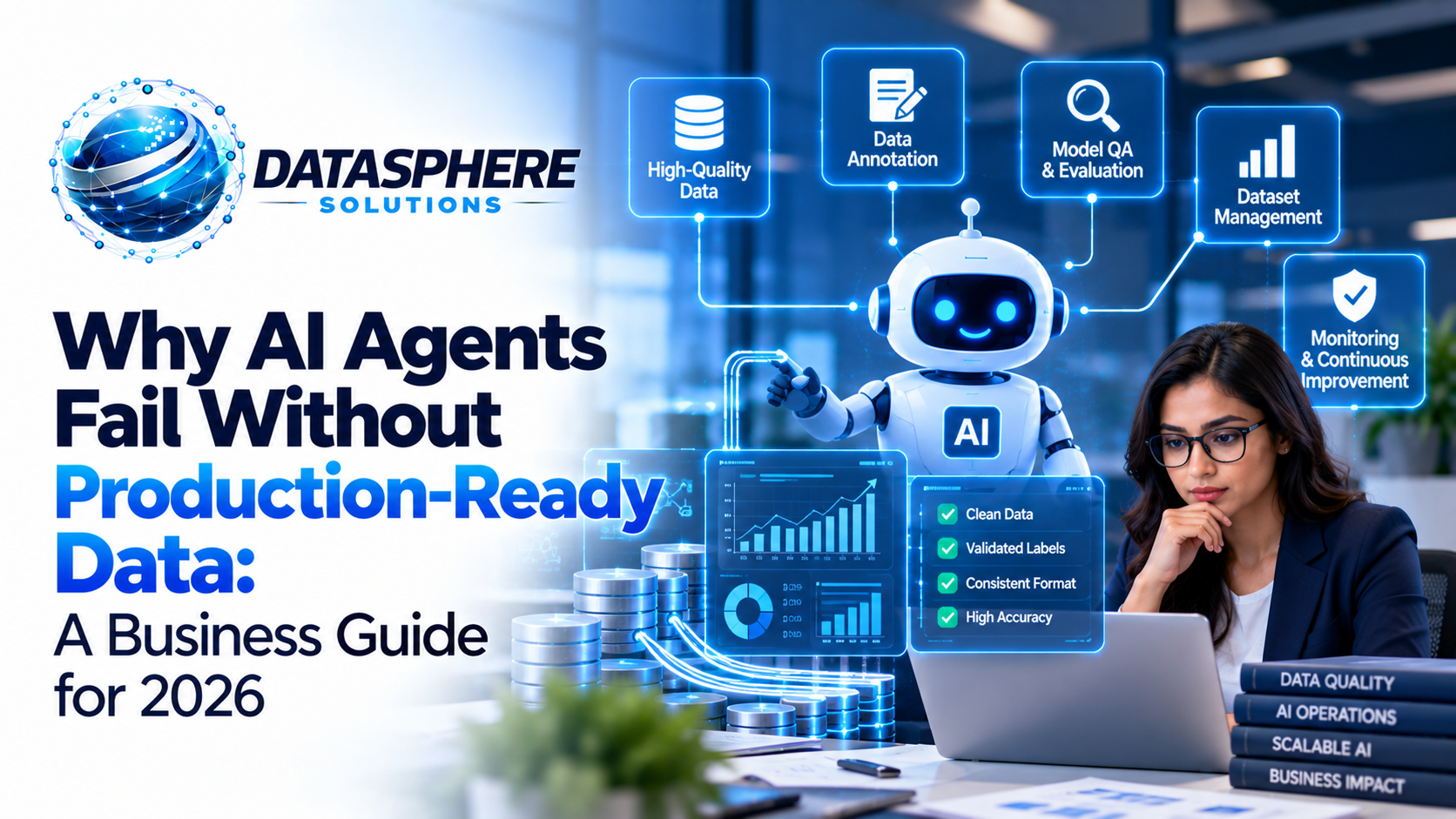
Artificial intelligence is moving beyond chatbots and content generation. Businesses are increasingly exploring AI agents that can retrieve information, complete multi-step tasks, support business workflows, and interact with enterprise systems. But there is a problem many organizations discover only after their first AI pilot: an intelligent model cannot consistently deliver reliable results when the data behind it is incomplete, inconsistent, outdated, or poorly governed. An AI agent may understand a request but retrieve the wrong information. A customer-facing assistant may provide an outdated answer. A document-processing workflow may misclassify records because its training examples are inconsistent. A model may perform well in testing but struggle when exposed to real-world data. These problems are not always caused by the AI model itself. They can originate in the operational processes that prepare, validate, organize, and monitor data. As businesses move from AI experimentation to production deployment in 2026, production-ready data is becoming a critical part of AI strategy. Organizations need more than powerful models. They need reliable datasets, consistent annotation, structured quality assurance, continuous evaluation, and well-managed operational workflows. This is where AI Data Operations becomes essential.
What Is Production-Ready Data for AI Agents?
Production-ready data is data that has been prepared, validated, documented, and managed to meet the requirements of a specific AI application.
It is not simply a large collection of records. The data must be relevant to the intended use case, sufficiently accurate, consistently structured, appropriately governed, and available when the system needs it.
For example, a retail AI agent that answers product questions needs accurate product descriptions, current availability information, consistent product attributes, and clear rules for handling missing information. A healthcare AI application may require carefully reviewed medical image labels and strict data-handling procedures. A financial document-processing model may need consistent extraction labels and reliable validation workflows.
Different applications require different data standards. The common requirement is that teams must understand what quality means for their use case and measure it consistently.
Production readiness also extends beyond the initial dataset. AI systems need ongoing evaluation because business information, user behavior, content, and operational conditions change over time.
Why AI Agents Struggle With Poor Data Quality
1. Inconsistent Training and Evaluation Data
AI models learn patterns from examples. When those examples are inconsistent, ambiguous, or incorrectly labeled, the model may learn unreliable patterns.
Imagine a dataset in which the same customer intent is assigned different labels by different annotators. The model may struggle to distinguish between categories that should be clearly separated.
These problems can remain hidden until the model encounters unfamiliar examples in production.
Structured annotation guidelines, representative datasets, reviewer training, and sampling-based quality checks can help reduce inconsistencies before data moves into model development or evaluation.
2. Incomplete or Outdated Information
AI agents often depend on information from documents, databases, knowledge bases, and business applications.
If those sources contain outdated policies, missing records, duplicate entries, or conflicting information, the agent may produce an incorrect response even when its underlying language model is capable.
Businesses should establish processes for identifying stale data, maintaining dataset versions, documenting sources, and reviewing changes. For retrieval-based AI applications, teams should also evaluate whether the system retrieves relevant and current information.
3. Weak Business Context
Data needs context to become useful.
A dataset containing product names, customer interactions, financial records, or support tickets may not explain how those records relate to business processes. Without appropriate metadata, definitions, and relationships, an AI system may misinterpret what the information means.
Gartner identified semantics, AI governance, and agentic data management among the major data and analytics trends for 2026. These developments reinforce the importance of connecting data to business meaning and controlling how AI systems use it.
For organizations building AI agents, this means preparing not just the data itself, but also the definitions, permissions, and context needed to interpret it correctly.
4. Insufficient Model Quality Assurance
A successful demonstration does not prove that an AI system is ready for production.
A model may perform well on a small test set but fail on uncommon inputs, ambiguous requests, edge cases, or unfamiliar content formats.
Teams need evaluation datasets that reflect realistic usage. They also need clear acceptance criteria, repeatable testing, error categorization, reviewer feedback, and regression testing when models or prompts change.
Without this process, organizations may deploy AI systems without understanding their limitations.
The Role of AI Data Operations
AI Data Operations covers the operational work required to prepare, validate, maintain, and improve the data and workflows used by AI systems.
It connects data preparation with quality assurance, model evaluation, monitoring, and continuous improvement.
Instead of asking engineers to manage every annotation backlog, dataset issue, or repetitive review task, businesses can establish dedicated operational workflows supported by trained specialists and appropriate tools.
The objective is to make AI development and deployment more consistent while allowing engineering and product teams to focus on model architecture, experimentation, integration, and product innovation.
Data Annotation and Labeling
Data annotation adds meaningful labels, categories, tags, or other structured information to raw data. Depending on the use case, this may involve text, images, audio, video, documents, or multimodal content.
A reliable annotation workflow includes clear instructions, representative examples, defined edge cases, quality checks, and escalation procedures for ambiguous records.
For complex projects, human reviewers can examine uncertain or high-impact examples while automated checks identify formatting errors and other measurable inconsistencies.
AI Model QA and Evaluation
Model QA evaluates whether an AI system produces outputs that meet predefined expectations.
This can include checking classification results, reviewing generated answers, identifying recurring errors, and comparing model outputs against reference examples.
Evaluation should reflect the real risks of the application. A product-tagging model may be judged on label accuracy and consistency, while a customer-facing AI assistant may need checks for factual reliability, relevance, policy compliance, and appropriate escalation.
A structured QA process helps teams understand where a model performs well, where it struggles, and which issues need attention before wider deployment.
Dataset Management and Version Control
Datasets evolve as businesses collect new information, correct errors, change labeling standards, or introduce new use cases.
Without version control and documentation, teams may find it difficult to reproduce experiments, compare model performance, or determine why results have changed.
Dataset management can include data collection, cleaning, deduplication, versioning, documentation, storage, and access coordination.
These practices support more repeatable development and make it easier to trace changes throughout the AI lifecycle.
Content Moderation
AI products that process user-generated content may require moderation workflows to identify prohibited, harmful, inappropriate, or policy-violating material.
Moderation operations can combine automated detection with human review, particularly for ambiguous cases or decisions with significant consequences.
Businesses should define their moderation policies, review thresholds, escalation procedures, and quality standards according to their products and applicable requirements.
Performance Monitoring
AI quality can change after deployment as input data, user behavior, business rules, and operating conditions evolve.
Performance monitoring helps teams identify unusual outputs, recurring errors, shifts in input patterns, and deviations from established benchmarks.
When an issue is detected, the workflow should define who investigates it, how the issue is categorized, when it is escalated, and how the resulting insight feeds back into evaluation or data improvement.
Prompt Operations
Generative AI applications often rely on prompts, instructions, templates, and contextual information to produce useful outputs.
Prompt operations include testing, refinement, version management, documentation, and systematic output evaluation.
Rather than changing prompts informally, teams can maintain documented versions, test them against representative cases, and compare results using consistent evaluation criteria.
This helps teams understand whether a change genuinely improves performance or simply produces better results on a narrow set of examples.
How to Build a Production-Ready AI Data Workflow
The first step is to define the business outcome. Organizations should identify what the AI application is expected to accomplish and what an acceptable result looks like. Accuracy, response quality, error tolerance, latency, compliance, and escalation requirements may all matter, depending on the application.
The next step is to assess the data. Teams should identify available sources, missing information, duplication, inconsistent formats, labeling gaps, access restrictions, and documentation problems. This assessment establishes a baseline before significant resources are invested in model development or deployment.
Data preparation and annotation should then follow documented standards. Teams need clear labeling rules, examples of difficult cases, reviewer responsibilities, and a process for resolving disagreements. Quality should be measured against agreed criteria rather than assumed from the volume of completed work.
Once the dataset is prepared, the model should be evaluated against representative examples, including edge cases and failure scenarios. Results should be documented, recurring errors categorized, and release criteria agreed upon before deployment.
Finally, the organization should establish ongoing monitoring and feedback. Production issues should inform evaluation updates, prompt improvements, annotation guidelines, or dataset revisions where appropriate.
This creates a continuous cycle: prepare, validate, evaluate, deploy, monitor, and improve.
Why Human Expertise Still Matters in AI Operations
Automation can accelerate repetitive work, but it does not eliminate the need for judgment.
Some records are ambiguous. Some outputs require domain expertise. Some moderation decisions need contextual review. Some model failures are difficult to detect through automated checks alone.
Human specialists can review uncertain cases, validate quality standards, investigate unusual outputs, and provide feedback that improves future workflows.
The right balance depends on the use case. Routine, clearly defined checks may be automated, while complex or high-risk decisions require stronger review and escalation.
The objective is not to maximize manual effort or automate every task. It is to combine automation and human expertise in a way that delivers reliable outcomes.
Build More Reliable AI With Better Data Operations
Prepare your AI workflows for scale with dedicated support for data annotation, model quality assurance, dataset management, content moderation, and prompt operations. DataSphere helps align AI operations with your workflows, tools, and quality standards.
Common Mistakes Businesses Should Avoid
One common mistake is measuring progress by the volume of data processed rather than the quality of the resulting dataset. A large dataset with inconsistent labels can create more work downstream instead of improving model performance.
Another mistake is treating QA as a final checkpoint. If annotation errors, unclear instructions, and missing metadata are allowed to accumulate, correcting them later can be expensive. Quality checks should be built into the workflow from the beginning.
Businesses should also avoid assuming that a successful pilot guarantees production readiness. Real-world deployment introduces new inputs, changing conditions, and operational demands that a small test may not represent.
Finally, organizations should not overlook governance. Data access, privacy, retention, documentation, and review requirements need to be defined before sensitive information is processed or AI systems are allowed to act on it.
How Dedicated AI Operations Teams Help Businesses Scale
As AI workloads grow, the operational demands behind them can expand quickly. Data annotation, model review, prompt testing, moderation, and monitoring may require sustained capacity that an internal engineering team cannot easily absorb.
A dedicated AI Operations team can provide structured support for these recurring activities. The team can work within the client's existing tools, workflows, documentation, and quality standards, with defined responsibilities and reporting.
This approach can help separate model development from repetitive operational work. Engineers and product teams can concentrate on building and improving AI products, while trained specialists manage the processes that keep data and evaluation workflows moving.
DataSphere's AI & Data Operations service supports data annotation across image, text, audio, and video; AI model QA; dataset management; content moderation; performance monitoring; and prompt operations. Its team model is designed around the client's pipeline, tools, and quality standards.
For businesses facing annotation backlogs, inconsistent review results, or limited operational capacity, dedicated support can provide a more structured way to manage AI data workflows as demand increases.
What Businesses Should Measure
AI Data Operations should be evaluated using metrics that reflect the actual requirements of the application.
Depending on the use case, useful measures may include annotation accuracy, reviewer agreement, defect rates, dataset completeness, QA turnaround time, evaluation coverage, recurring error rates, moderation quality, and time required to resolve exceptions.
Teams should also monitor the downstream impact of data improvements. For example, changes in annotation standards can be evaluated against model performance on a consistent test set. Improvements in prompt operations can be assessed through repeatable evaluations rather than subjective impressions alone.
No single metric proves that an AI system is ready for production. A combination of data quality, model evaluation, operational reliability, security, and business outcome measures provides a more useful picture.
Conclusion
AI agents are creating new opportunities for businesses to automate workflows, improve information access, and build more capable digital products. But reliable AI depends on much more than the model.
Data quality, annotation standards, dataset management, model QA, prompt operations, moderation, and continuous monitoring all influence whether an AI application can perform consistently in real-world conditions.
Organizations that invest in these operational foundations can make AI development more structured and create a clearer path from experimentation to production.
For businesses that lack the internal capacity to manage these activities, dedicated AI Data Operations can help address operational bottlenecks while allowing engineering teams to focus on innovation.
The path to reliable AI is not just about building a smarter model. It is about building the data and operational processes that help it work reliably at scale.
Frequently Asked Questions
What is production-ready data for AI?
Production-ready data is data that has been prepared, validated, documented, and managed to meet the needs of a particular AI application. It should follow appropriate quality, context, security, and governance requirements.
Why do AI agents need high-quality data?
AI agents depend on reliable information to retrieve facts, interpret context, and complete tasks. Incomplete, inconsistent, or outdated data can lead to incorrect outputs and unreliable workflow execution.
What is AI Data Operations?
AI Data Operations refers to the processes and teams responsible for data annotation, dataset management, quality assurance, model evaluation, content moderation, performance monitoring, and related AI workflows.
What is the difference between data annotation and model QA?
Data annotation adds labels or structured information to raw data. Model QA evaluates whether an AI system's outputs meet defined quality and performance expectations. Both activities contribute to building and maintaining reliable AI applications.
Can AI Data Operations be outsourced?
Yes. Businesses can use dedicated external teams to support recurring data and AI operations, provided the engagement has clear quality standards, security controls, responsibilities, and reporting requirements.
What AI Data Operations services does DataSphere provide?
DataSphere's AI & Data Operations service includes data annotation, AI model QA, dataset management, content moderation, performance monitoring, and prompt operations. The team model is designed to align with a client's existing tools, workflows, and quality standards.
How can businesses improve AI data quality?
Businesses can start by defining quality requirements, documenting annotation guidelines, validating datasets, reviewing model outputs, tracking recurring errors, and creating a continuous feedback loop between production monitoring and data improvement.