



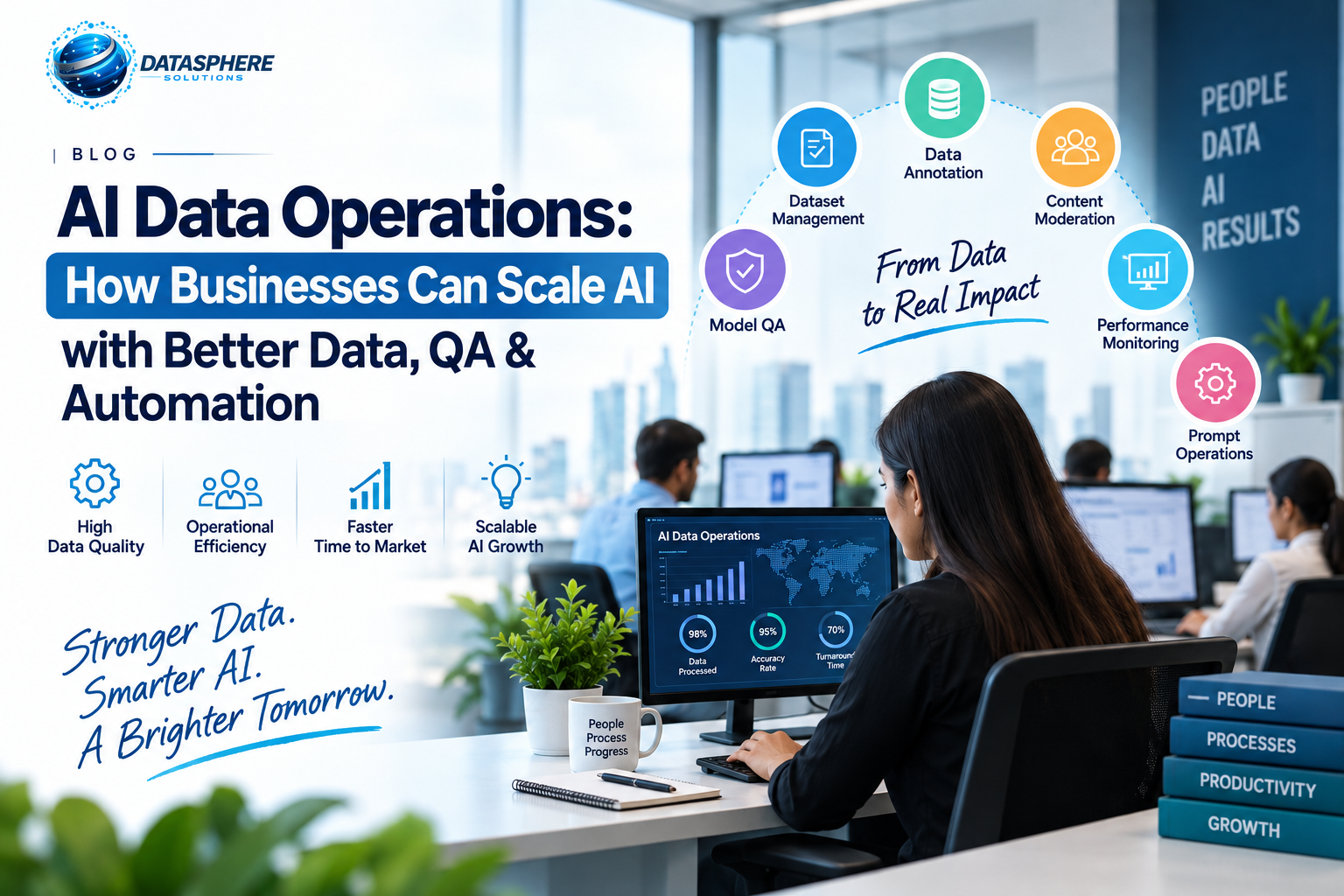
AI Data Operations is becoming a critical part of building and scaling reliable artificial intelligence systems. While businesses often focus on AI models, algorithms, and applications, the operational work behind those technologies is equally important. From data annotation and dataset management to AI model QA, content moderation, performance monitoring, and prompt operations, every stage can influence the quality and effectiveness of an AI solution. As AI workloads grow, businesses need structured processes and specialized teams to manage these activities efficiently. A well-designed AI Data Operations strategy can help organizations improve data quality, reduce operational bottlenecks, support AI development teams, and build a more scalable foundation for production AI.
AI Data Operations: The Operational Backbone Behind Scalable AI
Artificial intelligence may be powered by sophisticated models, but models are only as effective as the data, quality processes, and operational workflows behind them.
As companies scale AI products, many teams discover that the biggest bottleneck isn't always model development. Data annotation backlogs, inconsistent datasets, quality issues, content moderation, prompt testing, and ongoing model monitoring can consume significant engineering and product resources.
This is where AI Data Operations becomes essential.
AI Data Operations provides the operational layer required to keep AI pipelines moving efficiently—from preparing training data to reviewing model outputs and continuously improving workflows.
What Are AI Data Operations?
AI Data Operations refers to the processes and teams responsible for preparing, managing, validating, and improving the data and operational workflows used by AI systems.
These activities can include:
- Data annotation and labeling
- Dataset collection and cleaning
- Data quality assurance
- AI model output review
- Content moderation
- Model performance monitoring
- Prompt testing and optimization
- Dataset versioning and management
For businesses developing AI applications, these activities are critical because poor-quality or inconsistent data can affect downstream model performance.
Datasphere provides dedicated offshore AI Operations teams designed around a company's existing tools, workflows, and quality standards.
Why AI Teams Need Dedicated Data Operations
Building an AI product involves much more than training a model.
Engineering teams may need to continuously prepare datasets, review outputs, identify errors, test prompts, and maintain operational workflows. When these repetitive tasks remain with engineers and product teams, valuable development capacity can be diverted away from core product work.
Three common challenges stand out.
1. Data Annotation Backlogs
AI models often require large volumes of accurately labeled data.
For computer vision applications, this could involve labeling objects in images or video. For NLP applications, teams may need to classify text, identify entities, evaluate sentiment, or categorize conversations.
When annotation volumes increase faster than internal capacity, data preparation can become a bottleneck.
Datasphere supports image, text, audio, and video annotation across different dataset formats.
2. Inconsistent Data Quality
More data doesn't automatically mean better AI.
Incorrect labels, inconsistent annotation guidelines, duplicate records, missing information, and inconsistent review processes can reduce dataset quality.
A dedicated QA process can help identify errors before they move further down the AI pipeline.
Datasphere's AI Operations offering includes QA reviewers who review annotated outputs, identify inconsistencies, and maintain defined quality standards.
3. Engineers Spending Time on Operational Work
AI engineers should ideally spend their time on model development, architecture, experimentation, and product innovation.
However, repetitive operational tasks can gradually consume engineering bandwidth.
Moving structured data operations to a dedicated team can help separate AI development work from AI operational work, allowing technical teams to focus on higher-value activities.
Key AI Data Operations Services
A scalable AI operation requires several connected capabilities.
Data Annotation
Data annotation converts raw information into structured training data that AI systems can learn from.
Depending on the use case, annotation can involve:
- Image labeling
- Text classification
- Audio transcription
- Video annotation
- Object detection
- Sentiment classification
- Entity identification
- Multimodal data labeling
High-quality annotation requires clearly defined guidelines, consistent execution, and ongoing quality checks.
AI Model Quality Assurance
Model QA focuses on reviewing AI outputs and identifying errors or inconsistencies.
A structured QA process can include:
- Output evaluation
- Error identification
- Quality scoring
- Edge-case review
- Feedback collection
- Continuous improvement loops
Datasphere describes AI Model QA as including output review, error flagging, and feedback loops designed for continuous improvement.
Dataset Management
AI datasets need to be collected, cleaned, organized, versioned, and maintained.
Without effective dataset management, teams can encounter problems such as:
- Duplicate records
- Outdated training data
- Inconsistent formats
- Missing metadata
- Poor version control
- Difficulty reproducing previous experiments
Datasphere's service includes collection, cleaning, versioning, and storage of training datasets.
Content Moderation
AI-powered platforms often process large volumes of user-generated content.
Content moderation operations can help businesses review text, images, and video content according to defined policies and workflows.
Datasphere supports both real-time and batch moderation workflows across these content types.
AI Performance Monitoring
Deploying an AI model isn't the end of the process.
Models need ongoing monitoring to identify unexpected outputs, anomalies, and changes in performance.
AI performance monitoring can involve:
- Tracking model outputs
- Comparing results against benchmarks
- Identifying anomalies
- Reviewing error patterns
- Escalating recurring issues
- Feeding insights back into the development process
This creates a continuous operational feedback loop between production data and AI teams.
Prompt Operations
The rise of generative AI has created another operational requirement: prompt management.
Prompt operations can involve:
- Prompt testing
- Prompt refinement
- Version management
- Output evaluation
- Documentation
- Use-case-specific optimization
Datasphere includes prompt testing, refinement, and documentation as part of its AI Operations capabilities.
How Offshore AI Data Operations Can Support Growth
For companies scaling AI products, building every operational function internally may not always be practical.
A dedicated offshore AI Operations team can provide additional operational capacity while working within the company's existing tools and processes.
Datasphere describes its AI Operations model as building dedicated teams around the client's pipeline, tools, and quality standards rather than using a generic workflow.
This approach can help businesses:
- Increase data processing capacity
- Reduce annotation backlogs
- Maintain consistent quality standards
- Support larger AI workloads
- Free internal engineering capacity
- Establish repeatable operational workflows
- Scale teams as operational requirements change
AI Data Operations Across Industries
AI data workflows vary significantly depending on the industry.
SaaS & Technology
AI product companies may need annotation, model QA, moderation, and prompt operations to support AI-powered applications.
Healthcare & Life Sciences
Healthcare AI can involve medical image labeling, clinical data processing, and workflows that require strong attention to compliance and data quality.
E-commerce & Retail
Retail businesses can use AI Operations for product data enrichment, visual tagging, catalog management, and other high-volume data workflows.
Financial Services
Financial institutions may require document processing, data extraction, model monitoring, and other operational workflows within regulated environments.
Datasphere specifically identifies SaaS & Technology, Healthcare & Life Sciences, E-commerce & Retail, and Financial Services as sectors supported by its AI Operations teams.
Scale Your AI Operations Without Slowing Down
Your AI team shouldn't spend valuable time managing data backlogs, repetitive QA, or manual annotation workflows. Datasphere Solutions provides dedicated AI Data Operations support to help manage data annotation, model QA, dataset management, content moderation, and prompt operations—so your team can focus on building and scaling AI solutions.
Building a Reliable AI Operations Workflow
A strong AI Operations model should not simply focus on processing more data.
It should create a repeatable workflow:
Data Collection → Annotation → Quality Review → Dataset Management → Model Training → Output Evaluation → Monitoring → Feedback → Improvement
Each stage contributes to the reliability of the overall AI pipeline.
The objective is to create an operational system where issues are identified early and feedback continuously improves the process.
AI Operations vs. AI Development
These two functions are connected, but they are not the same.
The distinction allows engineering and data science teams to concentrate on product and model development while specialized operations teams manage repeatable data workflows.
What Businesses Should Look for in an AI Data Operations Partner
Before outsourcing AI data operations, businesses should evaluate several factors.
Quality Management
Ask how annotation quality is measured, reviewed, and improved.
Scalability
The team should be able to handle changing data volumes without disrupting the AI pipeline.
Tool Compatibility
The operation should fit into the company's existing technology environment.
Industry Understanding
Healthcare, financial services, retail, and technology businesses may have very different data requirements.
Reporting and Accountability
Clear operational reporting helps teams understand throughput, quality, exceptions, and performance.
Data Security
AI workflows can involve sensitive or proprietary information, making appropriate security and access controls important considerations.
Why AI Data Operations Matter for the Future of AI
The AI market is moving from experimentation toward production.
As more companies deploy AI applications, operational complexity will increase. Models need high-quality data, production systems need monitoring, and AI workflows require continuous evaluation and improvement.
That means the competitive advantage isn't only about building a better model.
It is also about building the operational infrastructure that allows the model to perform consistently at scale.
AI Data Operations can provide that infrastructure.
Final Takeaway
AI innovation depends on more than algorithms.
Behind every production-ready AI system is a combination of data preparation, annotation, quality assurance, dataset management, monitoring, moderation, and continuous optimization.
For growing AI teams, dedicated AI Data Operations can provide the specialized operational capacity needed to keep these workflows moving while internal engineers and product teams focus on innovation.
Datasphere helps businesses build dedicated offshore AI Operations teams covering data annotation, AI model QA, dataset management, content moderation, performance monitoring, and prompt operations.
If your AI pipeline is being slowed by data backlogs, quality issues, or repetitive operational work, building a dedicated AI Operations function can help create a more structured and scalable workflow.
Ready to build your AI Operations team? Explore Datasphere AI & Data Operations