


Artificial intelligence is moving beyond experimentation. In 2026, businesses are increasingly exploring how AI agents can execute multi-step workflows, support decision-making, automate repetitive processes, and improve operational efficiency. The challenge is no longer simply adopting AI technology. It is integrating AI into everyday business operations while maintaining accuracy, accountability, and human oversight. For organizations looking to scale, this transition requires more than AI software. It requires reliable data workflows, well-defined processes, skilled operational teams, and continuous performance monitoring. This is where AI Operations Services can help businesses bridge the gap between AI experimentation and practical business outcomes.
1. Why Businesses Are Moving Beyond Traditional AI Automation
Traditional automation generally follows predefined rules. AI agents introduce the possibility of handling more complex, multi-step tasks by interpreting context, planning actions, and interacting with connected systems within defined permissions.
For example, a conventional automated workflow might route a customer support ticket based on a keyword. An AI-assisted workflow could classify the issue, retrieve relevant information, suggest a response, and route exceptions to the appropriate specialist.
However, more sophisticated automation does not eliminate the need for operational controls.
Businesses must determine which activities can be automated, which require human approval, and how exceptions should be managed.
Common business applications include:
- Customer support ticket classification and routing
- Data extraction, validation, and enrichment
- Document processing and information management
- Sales operations and CRM data maintenance
- Finance and accounting workflow assistance
- Knowledge management and research support
- Quality assurance and operational reporting
The objective is to automate suitable repetitive work while allowing employees to focus on judgment, customer relationships, and complex decisions.
2. The Biggest Challenge: Turning AI Experiments into Reliable Operations
An AI pilot may demonstrate promising results in a controlled environment. Scaling that pilot across an organization introduces additional challenges.
Data Quality and Readiness
AI systems depend on relevant, consistent, and accessible information. Incomplete records, inconsistent formats, duplicate entries, and outdated documentation can undermine performance.
Businesses need structured data preparation, validation, enrichment, and ongoing maintenance to support dependable AI workflows.
Workflow Integration
AI tools must fit into existing business processes rather than operate as disconnected experiments.
Integration with CRM platforms, enterprise applications, ticketing systems, and internal knowledge bases requires clearly defined workflows, permissions, and escalation rules.
Quality Assurance and Human Oversight
AI-generated outputs may contain errors, omit important context, or require judgment that automated systems cannot reliably provide.
Organizations should establish review procedures, exception handling, performance monitoring, and clear accountability for important decisions.
Operational Capacity
Implementing AI creates work beyond configuring a model or purchasing software. Businesses must manage data pipelines, review outputs, maintain documentation, monitor workflows, and continuously improve processes.
Dedicated operational teams can help manage these responsibilities without requiring every business to build all capabilities internally.
3. How AI Operations Services Support Business Growth
AI Operations Services help businesses manage the activities that make AI systems useful in real-world environments.
Depending on the business requirements, these services can include:
Data Preparation and Processing
AI initiatives often require structured, high-quality datasets. Data operations teams can assist with data collection, labeling, classification, validation, annotation, and quality review.
These activities help prepare information for AI training, evaluation, and operational use.
AI Output Evaluation and Quality Review
AI systems need consistent evaluation to identify inaccurate outputs, incomplete responses, and recurring failure patterns.
Operational specialists can review outputs against defined guidelines, document exceptions, and provide feedback that supports continuous improvement.
Workflow Monitoring and Exception Management
Automated workflows do not always complete successfully. Missing information, unusual requests, integration failures, and ambiguous decisions may require human intervention.
Operational teams can monitor queues, investigate exceptions, follow escalation procedures, and coordinate resolution with the appropriate stakeholders.
Documentation and Knowledge Management
AI systems are only as useful as the information available to them.
Maintaining accurate knowledge bases, process documentation, operating procedures, and internal reference materials helps organizations improve consistency across both automated and human-led workflows.
Human-in-the-Loop Operations
Some activities should remain subject to human review, especially when they involve sensitive information, financial consequences, customer commitments, or complex decisions.
A human-in-the-loop model establishes clear boundaries between automated execution and human judgment.
4. Combining AI with Customer Support Operations
Customer service is one area where AI-assisted workflows can improve efficiency, provided businesses implement appropriate controls.
AI can help categorize requests, recommend responses, summarize conversations, and identify common customer issues.
However, complex complaints, unusual technical problems, sensitive requests, and exceptions may still require trained support professionals.
A combined operating model can include:
- AI-assisted ticket classification and prioritization
- Automated routing for common requests
- Human handling of complex customer interactions
- Quality monitoring and response evaluation
- Escalation coordination
- Knowledge base maintenance
- Customer support reporting and workflow improvement
This approach allows organizations to explore automation while retaining human support where it adds value.
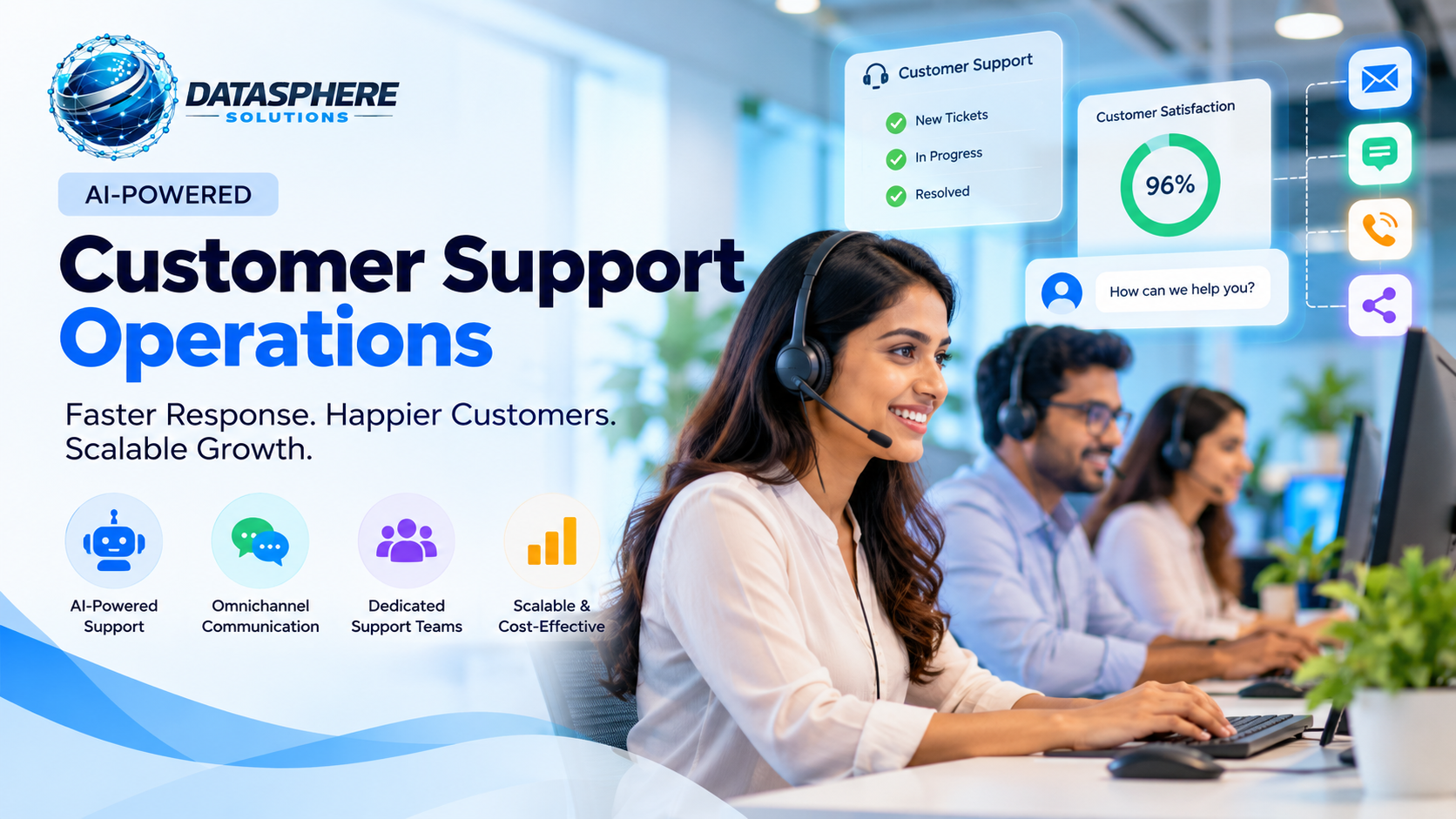
DataSphere's Customer Support Operations services can support businesses that need dedicated teams for customer-facing workflows, ticket management, and operational coordination.
The appropriate balance between automation and human support depends on ticket complexity, service-level requirements, customer expectations, and the reliability of the underlying AI systems.
Turn AI Potential into Operational Progress
From AI data preparation to customer support and back-office workflows, DataSphere helps businesses build dedicated teams aligned with their processes, quality standards, and growth goals.
5. Scaling Back-Office Operations with AI-Assisted Workflows
AI adoption is not limited to customer service. Many opportunities exist in the administrative and operational processes that keep businesses running.
Examples include:
Finance and accounting support: Organizing documents, processing routine records, validating information, and supporting reconciliation workflows under established controls.
Sales and revenue operations: Maintaining CRM records, validating lead information, supporting reporting, and coordinating recurring sales processes.
Administrative operations: Managing documentation, updating records, organizing requests, and coordinating repeatable workflows.
Research and documentation: Collecting information, maintaining reference materials, reviewing content, and organizing internal knowledge.
AI can assist with these activities, but business owners must define approval requirements, access controls, quality standards, and escalation procedures.
DataSphere's Back Office Operations, Finance & Accounting Support, and Sales & Revenue Operations services can help organizations manage these recurring operational responsibilities through dedicated teams.
6. Why Dedicated Offshore Teams Matter in the AI Era
AI technology alone does not create a scalable operating model. Businesses also need people who can manage workflows, maintain data quality, review outputs, coordinate exceptions, and keep daily operations running consistently.
Building every capability internally may require additional recruitment, training, management, and infrastructure.
A dedicated offshore team provides an alternative approach.
Depending on the scope of work, businesses can establish teams for:
- AI data preparation and quality assurance
- Customer support and escalation management
- Back-office processing and documentation
- Sales operations and CRM administration
- Finance and accounting support
- Workflow coordination and reporting
A well-designed offshore model should include documented responsibilities, defined service levels, quality metrics, secure access controls, and regular performance reviews.
The objective is not simply to reduce staffing costs. It is to create dependable operational capacity that can adapt as business requirements change.
7. A Practical Framework for Scaling AI Operations
Businesses do not need to automate every process simultaneously. A structured approach can help them identify suitable opportunities and reduce implementation risks.
Step 1: Identify Repetitive Workflows
Review existing processes and identify activities that consume significant time, follow predictable patterns, or create recurring backlogs.
Prioritize workflows with measurable outcomes and manageable risks.
Step 2: Assess Data and Process Readiness
Document the inputs, systems, business rules, dependencies, and exceptions associated with each workflow.
Identify data-quality problems and process gaps before introducing automation.
Step 3: Define Automation Boundaries
Determine which activities AI can perform, which require approval, and which must remain human-led.
Establish permissions, escalation procedures, and safeguards appropriate to the workflow.
Step 4: Establish Quality Metrics
Track performance using measures relevant to the process, such as:
- Processing time
- Error and rework rates
- Resolution time
- SLA compliance
- Escalation frequency
- Cost per completed task
- Customer satisfaction, where applicable
Define a baseline before implementation so that performance changes can be evaluated meaningfully.
Step 5: Build the Right Operational Support Model
Determine whether the required capabilities can be managed internally or whether a dedicated external team would provide a more practical way to handle recurring work.
Clarify ownership, communication channels, security requirements, and reporting responsibilities.
Step 6: Review and Improve Continuously
Monitor workflow performance, review exceptions, update documentation, and refine operating procedures as requirements evolve.
Expand automation only when the process demonstrates sufficient reliability and the appropriate controls are in place.
8. Choosing the Right AI Operations Partner
An effective operations partner should offer more than access to additional personnel.
Before selecting a provider, evaluate the following factors:
Workflow alignment: Can the team work within your existing tools, processes, and communication channels?
Quality management: Are responsibilities, review procedures, and performance metrics clearly defined?
Security and access controls: Can the provider meet your requirements for data protection, confidentiality, and system access?
Scalability: Can operational capacity change as your workload and business priorities evolve?
Accountability: Are reporting structures, escalation paths, and ownership clearly established?
Continuous improvement: Can the team identify recurring issues and help improve operational consistency?
The right partner should complement your internal capabilities while maintaining clear accountability for the work it performs.
Conclusion: Make AI Operational, Not Just Experimental
The next stage of enterprise AI adoption is about integrating intelligent systems into reliable, measurable business workflows.
Organizations need more than technology. They need clean data, well-defined processes, quality controls, human oversight, and operational teams capable of managing the work surrounding automation.
By combining AI-assisted workflows with dedicated operational expertise, businesses can pursue greater efficiency while retaining control over quality, security, and customer outcomes.
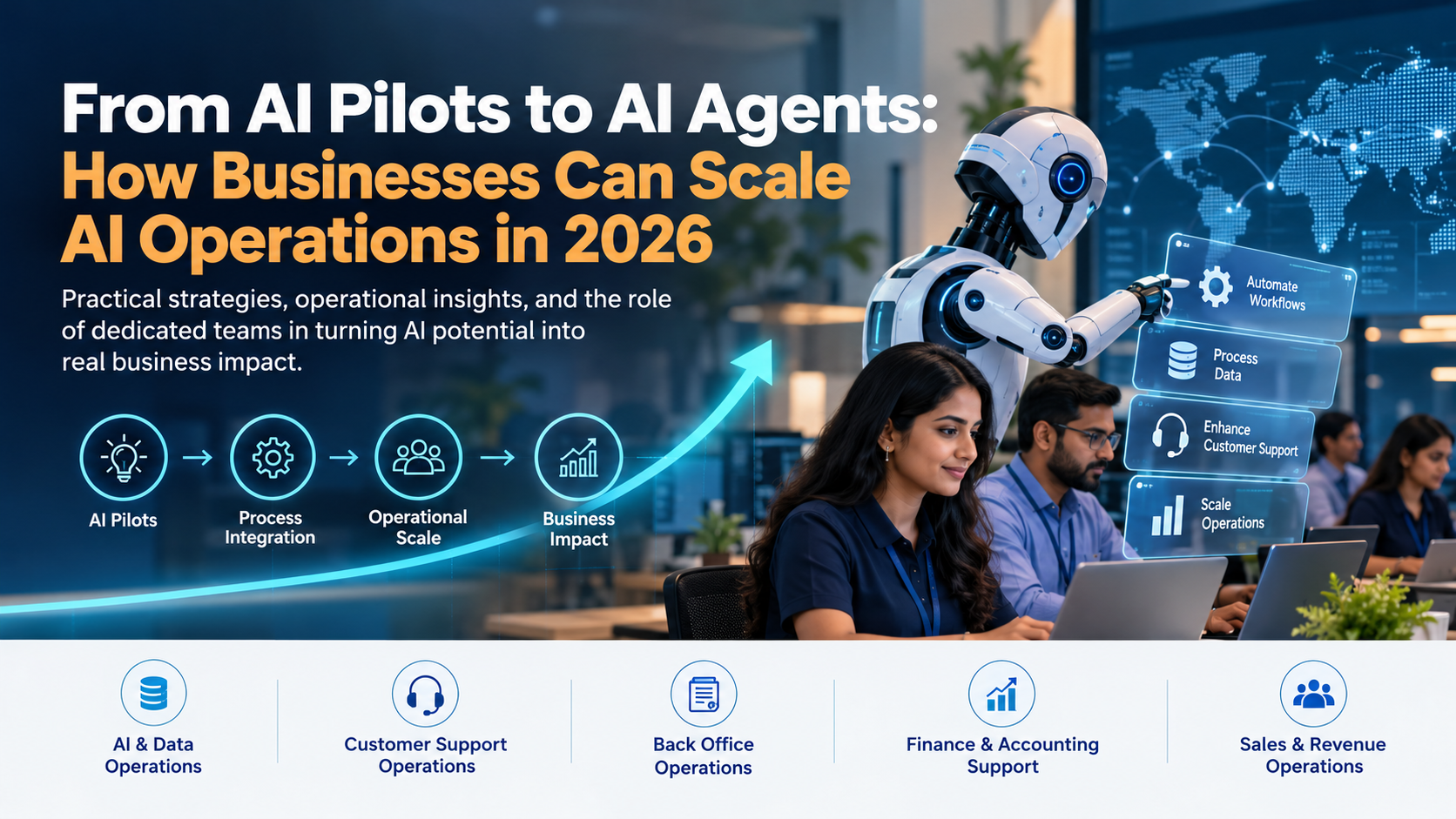
DataSphere helps businesses build dedicated offshore teams across AI & Data Operations, Customer Support Operations, Back Office Operations, Finance & Accounting Support, and Sales & Revenue Operations.
Whether you are preparing data for AI, managing customer support workflows, or scaling recurring business processes, the right operational model can help your organization build capacity around its priorities.
Ready to scale your business operations?
Explore DataSphere's services to discover how dedicated offshore teams can support your operational goals.
Visit https://dataspherepvtltd.com/services to learn more.